
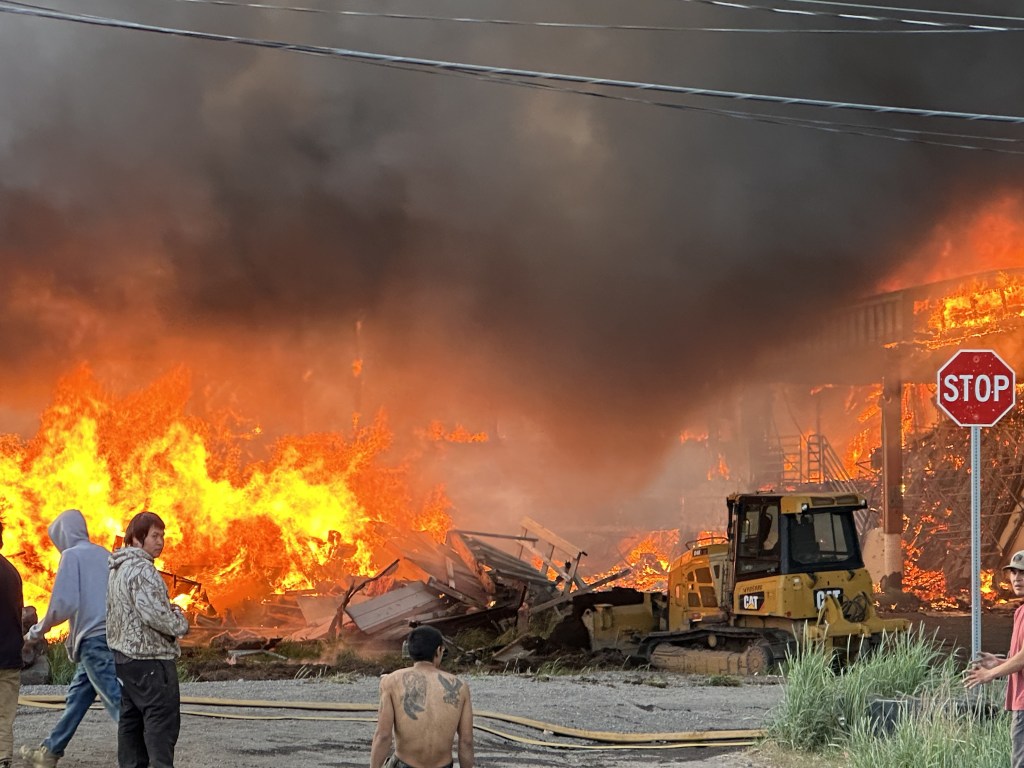
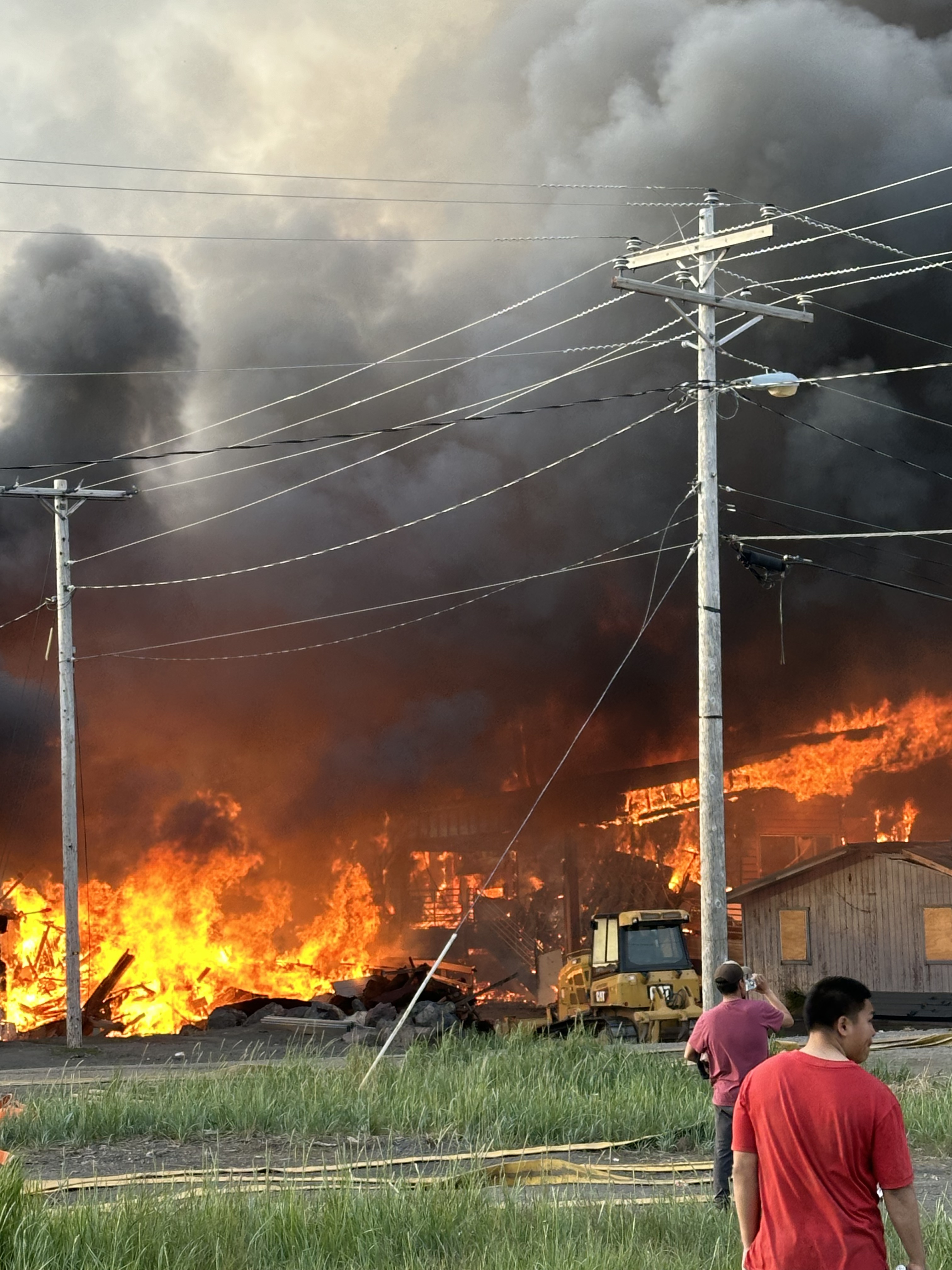
Tapraq employee Drexler Andrews was working with a crew re-leveling a teacher housing six-plex building when he saw smoke rising from the school maintenance facility nearby. He keyed the mic on his Tapraq radio. “School’s on fire! School’s on fire!”
Within moments Trapraq Rock employees from multiple locations and projects were responding to the fire, bringing company equipment and resources.
In a town with no fire department, and outside help an hour or more away, the only response that can make a difference involves what is already available within the community. In Stebbins, locally-owned Tapraq Rock, staffed by members of the community, became the town’s first line of defense against a growing inferno.
Joined by Stebbins city employees and community volunteers, Tapraq Rock personnel attacked the blaze.
City employees brought city pumps and hoses, while Tapraq Rock brought its own large pumps and hoses. Tapraq mechanics, directed by Bruce Pete, worked frantically to change hardware on pumps, hoses, and existing water supply equipment so that everything could be coupled together to provide water to hoses. Meanwhile, other employees and community members gathered buckets, large pots, and other containers and started bucket brigades from every available water source. An attempt was made to get the school sprinkler system operational to supply water by connecting a hose to it, but without success. Tapraq’s L260 loader began bringing buckets full of water up from the ocean and dumping it on the fire.
As the fire completely engulfed the utility building and external fuel oil tanks exploded, an electrical service pole between the building ignited. Bernard Pete, Tapraq foreman and AVEC worker, raced to the AVEC facility and shut down the town’s power. Workers, school employees, and others raced to save records, artifacts, historical photos of elders, and other irreplaceable items from the school.
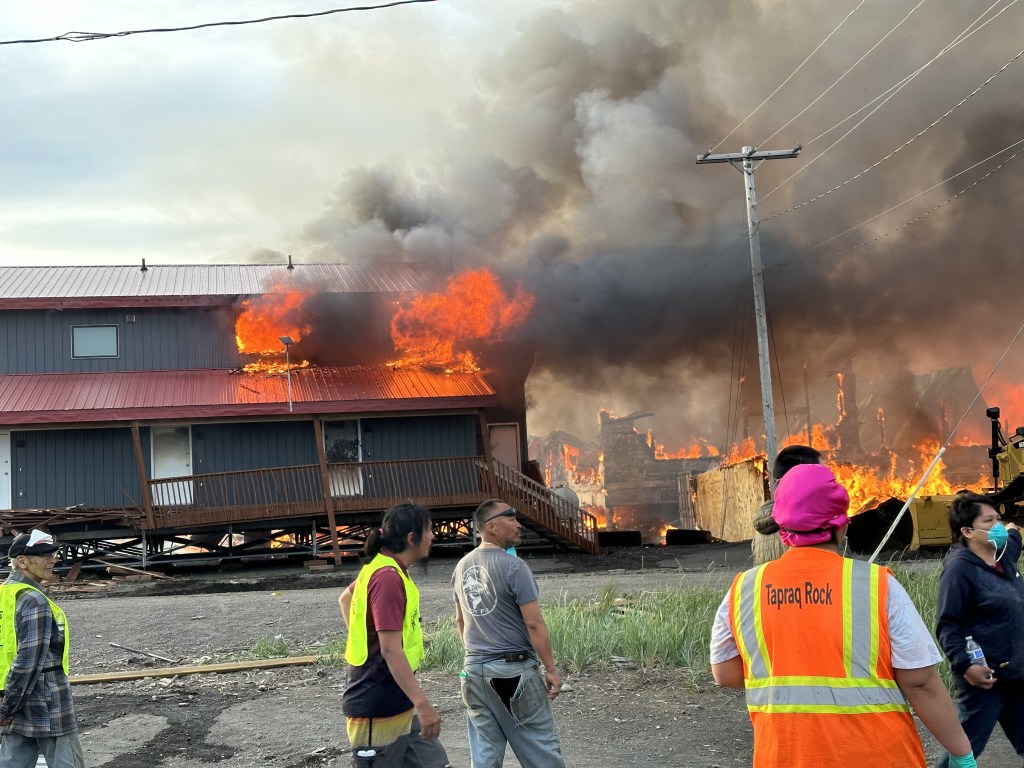
Tapraq Rock personnel set up their pump to draw water from the ocean, but the intake was not designed for pulling water from the surf on a gravel beach and sand and gravel repeatedly stopped the pump.
Meanwhile, Tapraq flaggers surrounded the blaze to ensure public safety, while lending a hand where needed.
An hour and a half after the fire was discovered, the Nome Voulnteer Fire Department arrived in three aircraft with some portable equipment. By this time, the fire had spread to the school building. Other entities were contacted for help, and urgent requests sent out for firefighting aircraft, but they declined to assist.
As NVFD firefighters struggled to position and start their pumps with the assistance of Tapraq mechanics and workers, the wind shifted and the fire spread in new directions. The NVFD suffered the same problems of clogging due to the sand-filled surf. Finally, pumps were marginally brought on line and and attempt was made to save some teacher housing units.
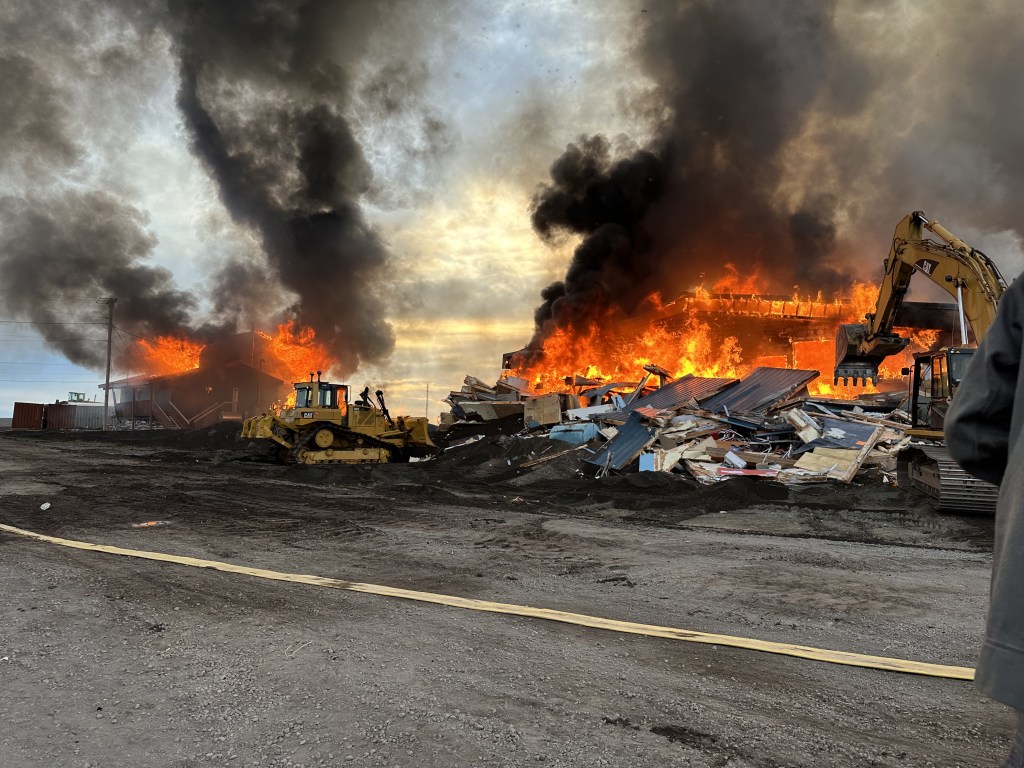
The school fire intensified and Tapraq used bulldozers, excavators, and a loader to push in walls to lower the height of the fire and prevent burning walls from collapsing outward toward other buildings. The L260 loader was used until the lift rams failed and the bucket could not be lowered or lifted. It continued to operate in this position until the heat the operator was exposed to became unbearable. After that the excavators, with their longer reach, continued this work.
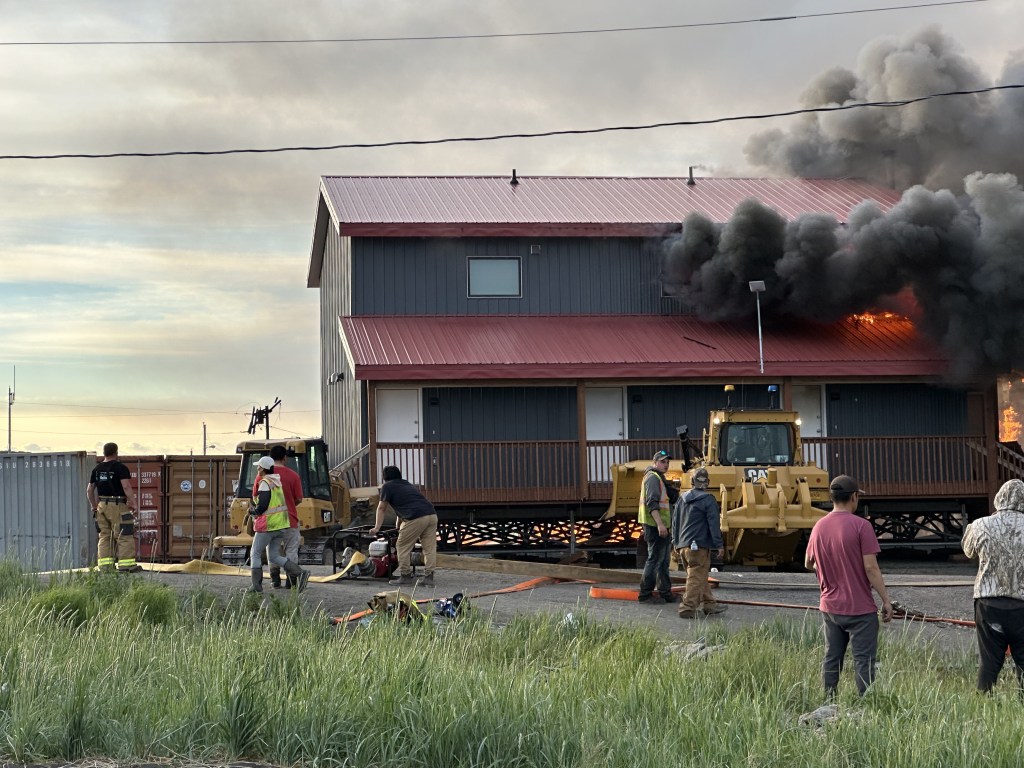
When the fire spread to additional buildings, Tapraq General Manager Dustin Scalisi directed the operators to knock down and remove buildings and create a firebreak to prevent the spread of the fire throughout the village. Tapraq’s D4 bulldozer, City employee Peter Martin, Jr. in the city’s D6 bulldozer, and Tapraq’s 345 excavator went to work clearing buildings and pushing burning debris back, while Bernard Pete cut the electrical service lines attached to the doomed buildings.
A total of ten buildings were destroyed including the school, outbuildings, portable classrooms and 10 individual housing units/apartments. Eight other buildings were damaged by heat, smoke, or water.
Tapraq Rock’s employees worked around the clock fighting and then containing the fire. After a couple hours sleep the next day, they were at it again.
But while flames still lit the wreckage of the school, Tapraq Rock was already fully engaged in disaster recovery work. Recognizing that scheduled barge space was already booked out for the short barging season, and a school start date was only weeks away, any solutions to get children back in school had to be immediate. This was a time for action, not negotiation. The school was the only building capable of serving as an emergency shelter or hosting community events, and contained most of the available modern infrastructure in the town.
Without waiting for contracts or for decisions to be made about where funding might come from, Tapraq Rock anticipated community needs and began to act. An entire barge was chartered at a cost of almost 1.5 million in anticipation of materials and equipment needed.
Tapraq purchased an 11,600 square foot 60 person mobile housing unit containing a full kitchen and cafeteria facilities, office spaces, 7 bathrooms for a total of 9 toilets, 8 showers, 12 sinks, 2 utility sinks. 4 laundry facilities offer 13 sets of washers and driers. It includes twin diesel generators, a 20,000 gallon potable water tank (very important in a town that often runs out of water by spring) a self-contained sewage treatment plant, making it self-sustaining in an emergency.
Tapraq also shipped two portable offices and a portable self-contained bathroom and shower facility.
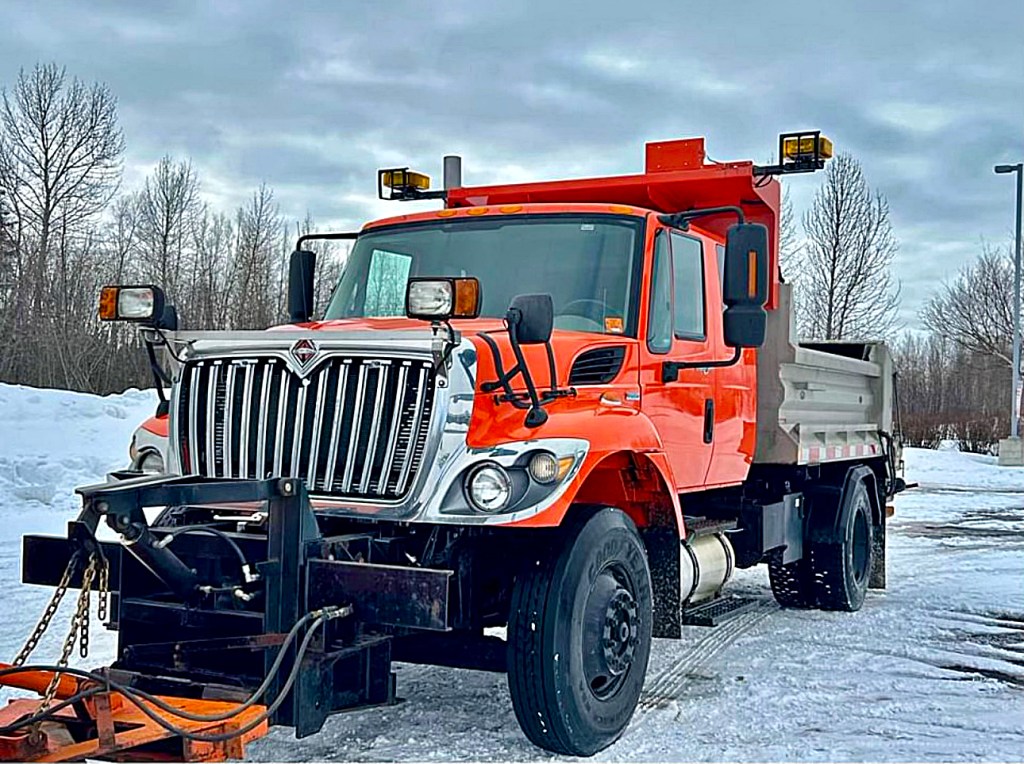
Told by BSSD that some of the students would need to be bussed to St. Michael to attend school, Tapraq immediately purchased 5 school busses, another road grader for road maintenance and snow removal, and a highway plow/sander truck. Work has already started to convert company buildings into heated bus barns.
Tapraq also purchased and sent 4 pickup trucks, another large excavator to handle debris cleanup, telehandler, manlift, and skid steer for handling materials and building construction, another electric car, and connex loads of building materials and emergency supplies.
While other entities were concerned about not being funded to assist with fighting the school fire, Tapraq was paying wages to its employees to fight the fire, risked its equipment, and lost equipment that was burned up in the fire.
While others talked of plans and contracts, Tapraq was putting money up front to make sure it was in a position to ensure that students had a school of some sort to attend in August.
What makes a contractor willing to dig deep and fight so hard for a community? It comes from being a part of the community.
Tapraq Rock is not an outside contractor that blows into town to make a quick buck. It is owned by the community of Stebbins through the Stebbins Native Corporation. We work for the residents of Stebbins. Our employees were fighting to save a school they attended as children; the school their children now attend. They were fighting to save their own families’ homes from the danger of fire spreading through the town. The future of Stebbins is the future of Tapraq Rock. And Tapraq rock is working for the future of Stebbins. Every decision is made with a purpose to bring long-term value to the community. This is how a community in western Alaska can be self-sufficient, able to immediately and decisively react to an emergency, and provide jobs and economic growth to its residents.
Growth can’t come from outside; it’s been tried. It hasn’t worked. Not from Washington D.C., not from Juneau, not from Nome. It has to be built from within. It takes local investment in infrastructure, local investment in training, local investment in families. It takes commitment through disasters, winter storms, and crawling out of bed at 3 a.m. into the wind and rain to start equipment and pull our neighbors’ boats up out of the storm surge. It takes fighting through the night, shoulder to shoulder with neighbors, family, and friends to prevent a fire from spreading through the town.
It takes a boots on the ground approach.
Tapraq Rock wants to recognize our employees (heroes) who fought the Stebbins school fire:
Connie Acoman, Traffic Control Supervisor
Alfred Andrews-Kirk Laborer
Drexler Andrews Laborer
Benny Atchak Laborer
Shana Atchak Laborer
Darryl Coffey, Building Trades, Plumber
George Flynn Haul Truck Forman
Cheryl Henry Flagger
Aiyaun Katcheak Laborer
Wilfred Katcheak, II Shop Foreman
Mitchell Ladd Mechanic
Karmin Lockwood Laborer
Peter Martin III Laborer
Sebastian Mike Fueler/oiler, Operator
Erik Milligrock Laborer
Bernard Pete, Sr. Civil Construction Foreman
Bruce Pete Maintenance Division Foreman
Dennis Pete Operator
Deynese Pete Flagger
Francis Pete, Sr. Haul truck driver
Keasha Steve Office Administrator
Luke Thrasher, Sr. Building Trades Foreman (Commercial)
Francis Williams Mechanic
Some of the following are also Tapraq employees:
City of Stebbins Employees:
Herbert Aluska, Jr.
Wayne Gabrieloff
Daisy Katcheak
Peter Martin, Jr.
Andrea Myomick
George Otten
Branson Pete
Edwig Pete, Jr.
Robert Tea
Community Volunteers:
Albert Bogeyaktuk, Sr.
Anatole Bogeyaktuk
George “Kelsey” Dan
Jeri Dan
Mary Dan
Phillip Dan
Jeri Dan
Mary Dan
Coby Jack
Lenny Katcheak
Roy Kirk
Jakobe Martin
Lawrence Martin
Gregory Mike
Royanna Mike
Rudolph Mike
Vernon Milligrock
Ronald Nick
Jordan Otten
Barbara “Dolly” Pete
Gladys Pete
John Pete
Roderick Pete
Lydia Raymond-Snowball
John Shelikoff
Didacus Snowball
Earl Washington
Community of St. Micheal Volunteers:
Joe Akaran
Francis “Petey” Lockwood
Harley Pete
Dominic Richardson
Jayare Zambas
Clinic Employees:
Digna Andrews
Deion Andrews
PA Bart
Arieanna Jack
Jacki Johnson
Serena Martin
Michelle Tom
Bering Strait School District Employees:
Garrett Coffey
Atha Foxie
Ray Hayworth
Camillus Pete
Taylor Kobuk, Sr.
Katherine Washington
Stebbins Native Corporation:
Ronald Kirk
Thomas Kirk
Our thanks to:
Gary Eckenweiler, Bering Straight School District
Nome Volunteer Fire Department responded to the fire
Bering Air transportation of personnel and equipment
Alaska State Troopers
Alaska Fire Marshals Investigation
 Tapraq Rock